
Skin quality
Chemical Peels in Montréal: Benefits, Recovery and Expectations
A guide to peel depth, skin renewal, recovery and questions to discuss before a chemical peel in Montréal.
The name makes people nervous, but the idea behind a chemical peel is simple: a carefully selected exfoliating solution is applied to the skin to remove damaged surface cells and encourage healthy renewal. The goal is skin that looks smoother, brighter, and more even. Peels are one of the oldest treatments in aesthetic medicine, and still one of the most useful.
What can a peel help with?
According to the American Academy of Dermatology, chemical peels can improve a wide range of concerns: dullness and lack of radiance, rough or uneven texture, dark spots and pigmentation, congestion and blemish-prone skin, fine lines, and some of the visible effects of sun damage (American Academy of Dermatology, n.d.).
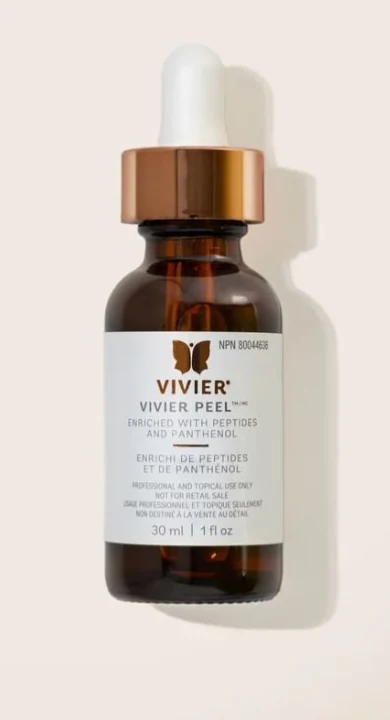
Different strengths address different concerns. A light, superficial peel refreshes the surface. Medium-depth peels reach further and can address more established pigment and texture concerns. The right depth is chosen for your skin and your goals, never the other way around.
What does the evidence say?
Peels have been studied directly with modern imaging. A 2023 study used line-field confocal optical coherence tomography, a non-invasive imaging technique, to watch what a chemical peel does to skin with post-inflammatory hyperpigmentation. The researchers were able to visualize and measure the peel's effects on inflammation, melanin, and collagen in living skin, documenting the renewal process that patients see as brighter, more even-toned skin (Razi et al., 2023).
What does a peel feel like, and what is the downtime?
A superficial peel may cause brief warmth or tingling. Healing generally takes 1 to 7 days for superficial peels, 7 to 14 days for medium peels, and 14 to 21 days for deep peels. Deep peels require a surgical setting and specialist aftercare (American Academy of Dermatology, n.d.). Your consultation will clarify the peel being offered and its recovery. Follow the prescribed aftercare and sun protection carefully.
Who should pause before peeling?
Peels are not for everyone at every moment. Active cold sores, certain skin conditions, recent isotretinoin use, and some skin types with a higher risk of pigmentation changes all call for caution and an experienced assessment first. This is exactly what a consultation is for: reviewing your skin, your history, and your goals before any solution touches your face (American Academy of Dermatology, n.d.).
Curious what a peel could do for your skin?
A peel plan is personal: the formula, the depth, and the number of sessions are all chosen around your skin. If dullness, uneven tone, or texture has been on your mind, book a consultation and we will map out an approach together. Results vary from person to person, and we will always tell you honestly what a peel can and cannot do for you.
Related services
Read next
Under-Eye Concerns in Montréal: Dark Circles, Fine Lines and Puffiness
Understand the differences between pigment, hollowing, fine lines and puffiness, and what an under-eye consultation in Montréal can clarify.
Collagen and Skin Firmness in Montréal: What to Know
A simple guide to collagen, gradual skin changes and the treatment options discussed at Le RoseWood in Montréal.
Skin Boosters in Montréal: Hydration and Skin Quality
What hyaluronic acid skin boosters can offer, their limits and how suitability is assessed during a Montréal consultation.
Consult in Montréal
A personalized consultation at Clinique Le RoseWood in Montréal.
108 Chemin de la Pointe N, Montréal, QC H3E 0E3
Book a consultationReferences
- American Academy of Dermatology. (n.d.). Chemical peels: FAQs. https://www.aad.org/public/cosmetic/younger-looking/chemical-peels-faqs
- Razi, S., Raquepo, T. M., Truong, T. M., & Rao, B. (2023). Analyzing the effects of a chemical peel on post-inflammatory hyperpigmentation using line-field confocal optical coherence tomography. Skin Research and Technology, 29(10), Article e13496. https://doi.org/10.1111/srt.13496